22115 - Computational Molecular Evolution: Difference between revisions
Jump to navigation
Jump to search
| (13 intermediate revisions by the same user not shown) | |||
| Line 1: | Line 1: | ||
; Overview [[File:Darwin logo2 medium.png |right|border|550px]] | ; Overview [[File:Darwin logo2 medium.png |right|border|550px]] | ||
: This page contains links to video lectures, computer exercises, and other material for the course [https://kurser.dtu.dk/course/22115 22115 - Computational Molecular Evolution], which is part of the [https://www.dtu.dk/english/education/msc | : This page contains links to video lectures, computer exercises, and other material for the course [https://kurser.dtu.dk/course/22115 22115 - Computational Molecular Evolution], which is part of the [https://www.dtu.dk/english/education/graduate/msc-programmes/bioinformatics MSc in Bioinformatics and Systems Biology] at the [https://www.dtu.dk/english Technical University of Denmark]. The course is taught by Professor Anders Gorm Pedersen, [https://www.healthtech.dtu.dk/english/Research/Research-Sections/Section-Bioinformatics Section for Bioinformatics], [https://www.healthtech.dtu.dk/english Department of Health Technology]. | ||
: The main goal of this course is to give an introduction to theory and algorithms in the field of computational molecular evolution. We will cover basic evolutionary theory (common descent, natural selection, genetic drift, models of growth and selection), and the main types of algorithms used for constructing and analyzing phylogenetic trees (parsimony, distance based methods, maximum likelihood methods, and Bayesian inference). We will also discuss the role of statistical modeling in science more generally | : The main goal of this course is to give an introduction to theory and algorithms in the field of computational molecular evolution. We will cover basic evolutionary theory (common descent, natural selection, genetic drift, models of growth and selection), and the main types of algorithms used for constructing and analyzing phylogenetic trees (parsimony, distance based methods, maximum likelihood methods, and Bayesian inference). We will also discuss the role of statistical modeling in science more generally | ||
| Line 12: | Line 12: | ||
=='''Computer setup'''== | =='''Computer setup'''== | ||
=== | ===MacOS=== | ||
:* [[ | :* [[MacOS software installation]] | ||
<!-- :* [[Notes on using | <!-- :* [[Notes on using MacOS for exercises]] '''UNDER CONSTRUCTION''' --> | ||
===Windows=== | ===Windows=== | ||
:* [[Windows software installation]] | :* [[Windows software installation]] | ||
<!--:* [[ | <!-- :* [[Windows software installation - Old Version]] --> | ||
=== | ===Linux=== | ||
:* [[ | :* [[Linux software installation]] | ||
<!-- :* [[Notes on using | <!-- :* [[Notes on using Linux for exercises]] '''UNDER CONSTRUCTION''' --> | ||
--> | |||
== '''Lecture Schedule''' == | == '''Lecture Schedule''' == | ||
| Line 34: | Line 28: | ||
:([[27615 Previous course programs|Course programs, previous years]]) | :([[27615 Previous course programs|Course programs, previous years]]) | ||
===Week 1 ( | ===Week 1 (February 4): Introduction to evolutionary theory and population genetics. Models of growth, selection and mutation=== | ||
:; Online lectures | :; Online lectures | ||
| Line 52: | Line 46: | ||
---- | ---- | ||
===Week 2 (February | ===Week 2 (February 11): Neutral mutations and genetic drift. Tree reconstruction by parsimony=== | ||
:; Online lectures | :; Online lectures | ||
| Line 72: | Line 66: | ||
---- | ---- | ||
===Week 3 (February | ===Week 3 (February 18): Consensus trees. Distance matrix methods=== | ||
:; Online lectures | :; Online lectures | ||
| Line 91: | Line 85: | ||
---- | ---- | ||
===Week 4+5 (February | ===Week 4+5 (February 25 + March 4): Mini project 1=== | ||
<!-- | <!-- | ||
| Line 108: | Line 102: | ||
---- | ---- | ||
===Week 6 (March | ===Week 6 (March 11): Models of sequence evolution. Likelihood methods=== | ||
:; Online lectures | :; Online lectures | ||
| Line 116: | Line 110: | ||
:; Course material | :; Course material | ||
:* [ | :* [[Media: Expectedchange.pdf | Handout exercise: Real, Observed, and Expected Change]] | ||
:* [https://teaching.healthtech.dtu.dk/material/22115/Handout_likelihood.pdf Handout exercise: Computation of Likelihood] | :* [https://teaching.healthtech.dtu.dk/material/22115/Handout_likelihood.pdf Handout exercise: Computation of Likelihood] | ||
:* [https://teaching.healthtech.dtu.dk/material/22115/Slides_week4.pdf Slides, week 6] | :* [https://teaching.healthtech.dtu.dk/material/22115/Slides_week4.pdf Slides, week 6] | ||
| Line 127: | Line 121: | ||
---- | ---- | ||
===Week 7 (March | ===Week 7 (March 18): Bayesian inference of phylogeny=== | ||
:; Online lectures | :; Online lectures | ||
| Line 136: | Line 130: | ||
:* [https://teaching.healthtech.dtu.dk/material/22115/Handout.class08.pdf Handout exercise: Bayesian estimation of model parameter value] | :* [https://teaching.healthtech.dtu.dk/material/22115/Handout.class08.pdf Handout exercise: Bayesian estimation of model parameter value] | ||
:* [https://teaching.healthtech.dtu.dk/material/22115/Slides_week5.pdf Slides, week 7] | :* [https://teaching.healthtech.dtu.dk/material/22115/Slides_week5.pdf Slides, week 7] | ||
:* [ | :* [[Media:MTN122.pdf|An Introduction to Bayesian Statistics Without Using Equations]] | ||
:* [http://www.nature.com/nbt/journal/v22/n9/pdf/nbt0904-1177.pdf Background reading: "What is Bayesian statistics?"] | :* [http://www.nature.com/nbt/journal/v22/n9/pdf/nbt0904-1177.pdf Background reading: "What is Bayesian statistics?"] | ||
:* [ | :* [https://gwern.net/doc/statistics/bayes/2003-brooks.pdf Background reading: "Bayesian computation: a statistical revolution"] | ||
:; Computer exercise | :; Computer exercise | ||
| Line 145: | Line 139: | ||
---- | ---- | ||
===Week 8+9 (March | ===Week 8+9 (March 25 + April 8): Mini project 2=== | ||
<!-- | <!-- | ||
| Line 156: | Line 150: | ||
---- | ---- | ||
===Week 10 (April | ===Week 10 (April 15): Model Selection=== | ||
:; Online lectures | :; Online lectures | ||
| Line 172: | Line 166: | ||
---- | ---- | ||
===Week 11 (April | ===Week 11 (April 22): Bayesian Phylogenetics, Part 2 === | ||
:; Course material | :; Course material | ||
:* [https://www.researchgate.net/publication/319965471_A_biologist%27s_guide_to_Bayesian_phylogenetic_analysis A biologist’s guide to Bayesian phylogenetic analysis] | :* [https://www.researchgate.net/publication/319965471_A_biologist%27s_guide_to_Bayesian_phylogenetic_analysis A biologist’s guide to Bayesian phylogenetic analysis] | ||
:* [https://beast.community/analysing_beast_output Analysing BEAST output using Tracer] | :* [https://beast.community/analysing_beast_output Analysing BEAST output using Tracer] | ||
:* [https://beast.community/tracer_convergence Identifying convergence problems using Tracer] | :* [https://beast.community/tracer_convergence Identifying convergence problems using Tracer] | ||
:* [https://taming-the-beast.org/tutorials/Troubleshooting/ | :* [https://taming-the-beast.org/tutorials/Troubleshooting-initialization-issues/ Troubleshooting initialization issues] | ||
:* [https://taming-the-beast.org/tutorials/Troubleshooting-convergence-issues/ Troubleshooting convergence issues] | |||
:; Computer exercise | :; Computer exercise | ||
| Line 185: | Line 180: | ||
---- | ---- | ||
===Week 12 + 13 (April | ===Week 12 + 13 (April 20 + May 6): Mini project 3: Final exam=== | ||
'''Details will follow''' | '''Details will follow''' | ||
---- | ---- | ||
Latest revision as of 23:36, 17 March 2026
- Overview
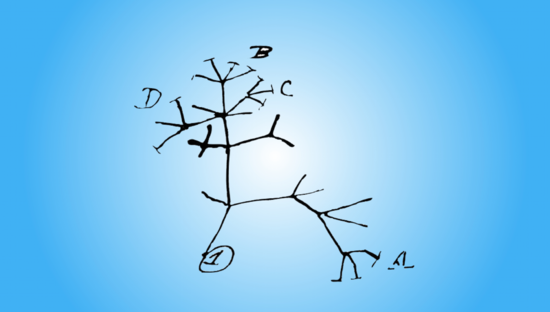
- This page contains links to video lectures, computer exercises, and other material for the course 22115 - Computational Molecular Evolution, which is part of the MSc in Bioinformatics and Systems Biology at the Technical University of Denmark. The course is taught by Professor Anders Gorm Pedersen, Section for Bioinformatics, Department of Health Technology.

- The main goal of this course is to give an introduction to theory and algorithms in the field of computational molecular evolution. We will cover basic evolutionary theory (common descent, natural selection, genetic drift, models of growth and selection), and the main types of algorithms used for constructing and analyzing phylogenetic trees (parsimony, distance based methods, maximum likelihood methods, and Bayesian inference). We will also discuss the role of statistical modeling in science more generally
- The course will consist of lectures, computer exercises, and mini-projects. The student will acquire practical experience in the use of a range of computational methods by analyzing sequences from the scientific literature.
Computer setup
MacOS
Windows
Linux
Lecture Schedule
Week 1 (February 4): Introduction to evolutionary theory and population genetics. Models of growth, selection and mutation
- Online lectures
- Computer exercise
Week 2 (February 11): Neutral mutations and genetic drift. Tree reconstruction by parsimony
- Online lectures
- Course material
- Computer exercise
Week 3 (February 18): Consensus trees. Distance matrix methods
- Online lectures
- Course material
- Computer exercises
Week 4+5 (February 25 + March 4): Mini project 1
Week 6 (March 11): Models of sequence evolution. Likelihood methods
- Online lectures
- Course material
- Handout exercise: Real, Observed, and Expected Change
- Handout exercise: Computation of Likelihood
- Slides, week 6
- Lecture notes: Substitution models
- Optional lecture notes: Matrix exponentials for Markov chains
- Computer exercises
Week 7 (March 18): Bayesian inference of phylogeny
- Online lectures
- Course material
- Computer exercise
Week 8+9 (March 25 + April 8): Mini project 2
Week 10 (April 15): Model Selection
- Online lectures
- Course material
- Computer exercise
Week 11 (April 22): Bayesian Phylogenetics, Part 2
- Course material
Week 12 + 13 (April 20 + May 6): Mini project 3: Final exam
Details will follow